


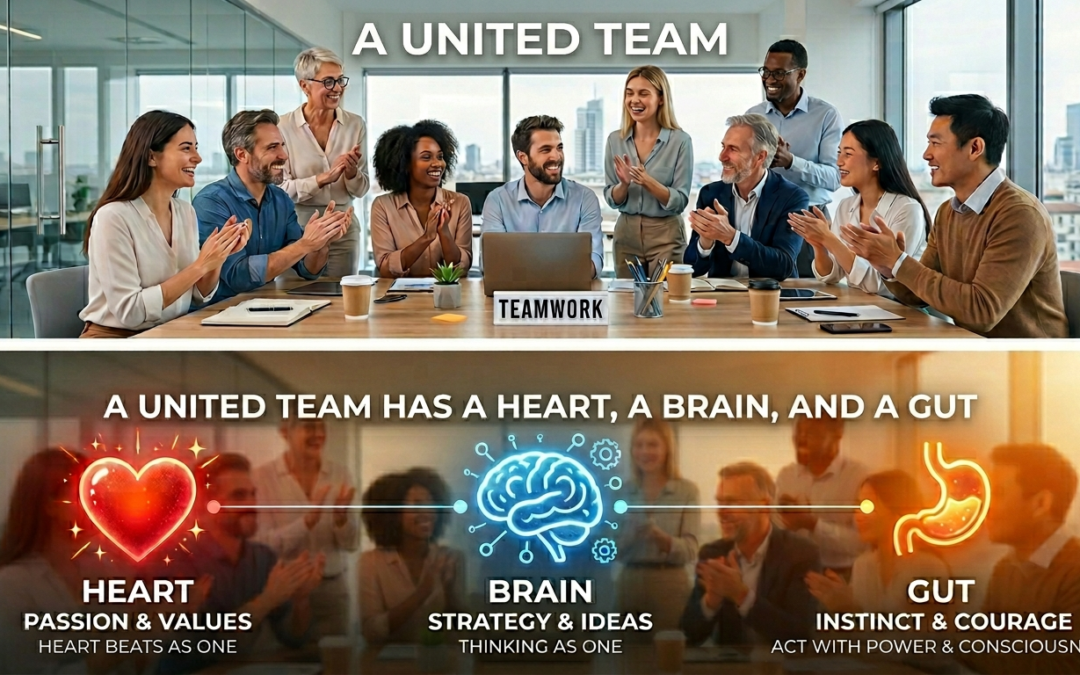
Head, heart and gut as three dimensions of alignment in groups navigating change.
In an age where AI is rapidly changing the way teams think, decide and organize work, one question becomes increasingly important:
What remains deeply human in a group?
Every team is made of people.
It sounds obvious, but we often forget it.
When we speak about groups, teams, professional communities or people working through change, we tend to describe them as abstract entities: the team needs to change, the group needs to be more aligned, people need to collaborate better, communication must improve.
All true.
But a team is not a machine.
A team is a human system.
And every person within that system brings at least three important centers of processing: a head, a heart and a gut.
The head thinks.
The heart feels.
The gut reacts, senses and perceives.
When people come together, these three dimensions do not remain separate. They influence one another. They amplify one another. Sometimes, they contradict one another.
And from this interaction, something very powerful emerges: a kind of group mind, group heart and group instinct.
In other words, every team develops its own way of thinking, feeling and reacting.
This is where coaching can become a powerful tool.
A Team Does Not Only Have a Strategy. It Has an Inner System.
When a group makes decisions, faces change or tries to evolve, the work often happens mainly at a rational level.
Goals.
Processes.
Roles.
Strategies.
Action plans.
Priorities.
All of these are important.
But they are not enough.
Because a group can have a clear strategy in its head, while its heart is not truly engaged and its gut does not yet trust the direction.
In a business or professional context, this matters because misalignment does not always appear as open conflict. Very often, it appears as delay, passive agreement, poor execution or decisions that are never fully implemented.
The result?
The team says it wants to change, but then returns to old habits.
The group agrees on a decision, but nobody really moves it forward.
People appear aligned in a meeting, but internally they remain doubtful, tense or disconnected.
Everyone seems to agree, but the next action is weak, fragmented or inconsistent.
This is one of the central points of coaching work with teams: helping the group recognize not only what it thinks, but also what it feels and what it perceives at a more instinctive level.
Head, Heart and Gut: Three Centers of Thought
I often use this image because it is simple, immediate and deeply understandable for human beings.
The head represents rational thinking: analysis, logic, planning, language, explanations and objectives.
The heart represents the emotional and relational world: values, belonging, trust, motivation, meaning and connection.
The gut represents intuition and immediate response: safety, alertness, instinct, energy, openness or closure toward something.
Of course, this is an operational metaphor, not a diagnosis. But it is a very useful metaphor because it helps people observe their internal functioning in a more complete way.
A person may say with the head:
“Yes, this is the right choice.”
But the heart may respond:
“I am not sure this truly respects what matters to me.”
And the gut may add:
“Something does not feel right. I do not feel completely at ease.”
When this happens, the person is not fully aligned.
And when many people in a team experience this dynamic, the group itself is not fully aligned.
Subconscious Beliefs in Groups
Every person brings their own beliefs into a team, including beliefs that are not fully conscious.
Some are personal:
“I cannot make mistakes.”
“If I say what I really think, I will be judged.”
“Change is risky.”
Others, over time, can become shared beliefs within the group:
“Here, it is better not to ask too many questions.”
“We have always done it this way.”
“Conflict should be avoided.”
These beliefs are not always declared. Often, they are never spoken openly.
But they can be seen.
They can be seen in silence.
They can be seen in meetings where nobody speaks up.
They can be seen in decisions that are constantly postponed.
This is where it becomes interesting to observe how the head, the heart and the gut may each be attached to different beliefs.
The head may believe:
“We need to innovate.”
The heart may feel:
“But I am afraid we will lose something important.”
The gut may react:
“I do not trust this yet. It feels safer to stay where we are.”
When these parts are not listened to, they do not disappear. They continue to operate beneath the surface.
What Is Fragmented Action?
I call fragmented action the kind of action that comes from incomplete alignment.
It happens when a person, or a group, acts with only one part of itself.
The head says yes.
The heart says no.
The gut says, “I don’t know.”
Or:
The head understands.
The heart does not engage.
The gut resists.
From the outside, it may look as if the group has made a decision. But inside, the energy is divided.
Fragmented action is easy to recognize.
People start, but without real conviction.
Decisions are made, then questioned again.
The team says, “We are ready,” but then slows down.
The problem is not a lack of intelligence.
It is not always a lack of competence.
It is not necessarily a lack of will.
Often, it is a lack of internal alignment.
And this applies both to individuals and to teams.
Fragmented action is dangerous because it creates unstable steps. It is like planting decisions in the soil of change when those decisions may look rational, but do not yet have sufficiently strong emotional, relational and intuitive roots.
In the short term, it may create the impression of movement.
In the medium term, it often generates confusion, resistance, delays and loss of trust.
A Simple Example
Imagine a group that needs to change the way it works.
The head of the team may say:
“This is necessary. The context has changed. We need to adapt.”
But the heart of the team may feel:
“Will this change make us lose our identity? Will our previous work still be recognized?”
And the gut of the team may react:
“Something is not clear. I do not know if we can trust this process yet.”
If the group only listens to the head, it may create a rational plan. Perhaps even a good one.
But if the heart and the gut are not included, that plan may remain fragile.
Because people do not act only on ideas.
People move when they perceive meaning, safety, trust and coherence.
The Role of AI and Human Coaching in Teams
Today, AI can be a very useful tool for teams.
It can help organize ideas, summarize conversations, prepare questions, analyze scenarios, build action plans and clarify decision-making processes.
In this sense, AI can strongly support the “head” of the team: structure, logic, alternatives, language and operational sequences.
But a team is not made only of rational thinking.
A team is also made of emotions, trust, tensions, intuition, hesitation, silence, unspoken concerns and subtle signals.
This is where human coaching becomes essential.
Human coaching does not simply produce answers.
It listens to how those answers are experienced.
It observes what happens in the group while people speak, react, close down, open up or avoid certain topics.
A human coach can help the team distinguish between:
what is being thought;
what is being felt;
what is being perceived but not yet expressed.
This is an important difference.
AI can help a group formulate a decision more clearly.
Human coaching can help the group understand whether that decision is truly integrated, sustainable and coherent for the people who will have to carry it forward.
The point is not to choose between AI and human coaching.
The point is to use them in the right way.
AI can be an excellent support for clarity, structure and preparation.
Human coaching remains essential when the work involves trust, alignment, emotions, beliefs, conflict, presence and real transformation within the group.
AI can help a team organize information more effectively, but it cannot, by itself, guarantee that all voices are truly heard.
This is also an important point when we speak about inclusion.
A group may have advanced technological tools and still remain poorly inclusive if some people do not feel free to express doubts, emotions, intuitions or divergent points of view.
This is why human coaching remains so valuable: not only to support better decisions, but to create the conditions in which differences can emerge, be heard and become part of the quality of dialogue and action.
What NEF™ Can Support in This Context
In group work, Neuro Emotional Facilitation™ — NEF™ can offer an interesting form of support because it helps people bring attention to different levels of their internal experience.
It is not about replacing coaching.
And it is not about turning group work into therapy.
It is about facilitating greater awareness of what happens inside a person while they participate in a collective dynamic.
Three questions can already open an important space:
What do I really think about this situation?
What do I feel, beyond the rational answer?
Which part of me is ready to act, and which part is still resisting?
Of course, in a coaching or facilitation process, many other questions can be explored. But even these three can help create an initial distinction between thought, feeling and internal response.
When these questions enter group work, the quality of the conversation changes.
The team stops talking only about what needs to be done and begins to observe how it is arriving at those actions.
And very often, this is where the most useful information emerges.
A Recent Experience in a NEF™ Seminar
During a recent NEF™ seminar I led a few weeks ago, this dynamic became very clear.
The group had a precise idea in its head. Rationally, people seemed to know what the right thing to do was, which direction to take and which choice appeared most logical.
But when we brought attention also to the heart, something different emerged.
The heart was telling another truth.
Not necessarily an opposite truth, but a different one. More nuanced. More vulnerable. More connected to meaning, trust, the fear of losing something and the need to be recognized.
It was interesting to see how, by listening to this level as well, the group began to understand its own hesitation more clearly.
It was not incoherence.
It was not weakness.
It was not lack of will.
It was information.
One part of the system had understood.
Another part was not yet ready.
Another part needed more listening before moving forward.
This is exactly the point: when a group learns to listen to its three centers, it becomes more capable of acting with integrity.
A Coherent Team Is Not a Team That Always Agrees
A coherent team is not a team where everyone always agrees.
It is a team where differences can emerge without breaking the relationship.
This is also where the theme of inclusion becomes important.
Inclusion is not only about having different people in the same space. It is about creating the real possibility for different thoughts, sensitivities, intuitions and ways of perceiving a situation to be heard without being immediately corrected, judged or excluded.
In a group, one person may bring the clarity of the head.
Another may bring the sensitivity of the heart.
Another may bring a gut intuition that is initially difficult to explain, but contains important information.
An inclusive team is not a team that flattens differences in order to avoid tension.
It is a team that learns to distinguish between destructive conflict and useful difference.
It is a team where dissent can be heard without immediately being interpreted as sabotage.
It is a team where what the head decides, the heart feels and the gut perceives can become part of a more honest conversation.
In this sense, inclusion and coherence are deeply connected.
Because a group is truly inclusive not only when it welcomes different people, but when it allows different forms of human intelligence to contribute to the quality of shared action.
Coherence does not come from eliminating differences.
It comes from the ability to integrate them.
Three Useful Questions for a Team
A group that wants to work at this level can begin with three fundamental questions:
What is the head of the team thinking?
What is the heart of the team feeling?
What is the gut of the team communicating, even if we have not yet said it out loud?
These questions do not slow the work down.
Very often, they prevent far more costly slowdowns later.
Because an action that is not integrated will eventually present its bill.
From Fragmented Groups to Conscious Teams
Many teams do not simply need more motivation.
They need more listening.
More clarity.
More language.
More courage to name what is already present.
Fragmented action emerges when a group tries to act without listening to all the parts involved.
Conscious action emerges when the group is able to recognize what it thinks, what it feels and what it perceives before moving forward.
This does not make change easy.
But it makes it more human.
More sustainable.
More real.
Because a team does not change only when it understands what it has to do.
It changes when it can create coherence between what it thinks, what it feels and what it is ready to act upon.
And perhaps this is where one of the most important qualities of a group begins: not perfection, but integrity.
The ability to move together without leaving important parts behind.
For leaders, facilitators, coaches and teams working through change, this may become one of the essential skills of the coming years: learning how to combine technological intelligence with human coherence.
AI can help us think faster.
Inclusion helps us listen better.
Human coaching can help teams act with greater integrity.